





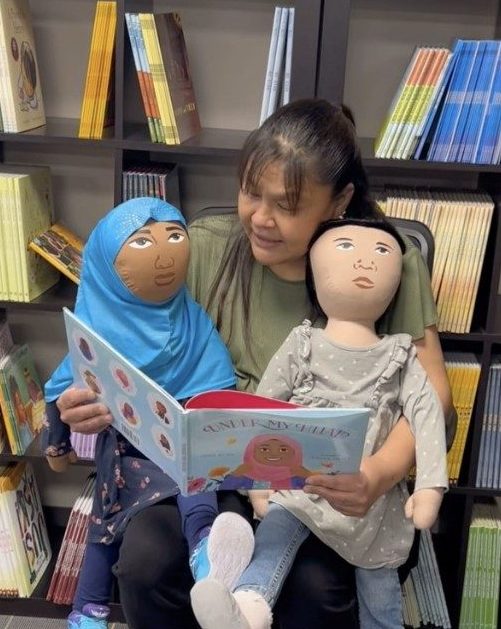
The following stories are meant to be used with Persona Dolls, classroom friends to help you support the social and emotional well-being of the children you work with. These stories came as a response to the growing presence of federal immigration officers in cities across the country over the past year, the recent events in Minneapolis, and the need for educators to have more tools to navigate tricky conversations with children.
Additionally, see these tips for talking to young children, including suggested language to use.
Educators are doing so much to support children, especially those living in areas where people are scared and sheltering in their homes due to fear of immigration detention and deportation. Reaching out to families to provide an opportunity to explore and name the feelings they are experiencing can be one way to show support. A couple of options include:
Pronouns: Please note, we refer to the persona dolls using the pronouns they/them/theirs. You may replace these pronouns with gender-specific pronouns that fit your Persona Doll’s identity.
Additional Resources: For more resources, including book recommendations, videos, and discussion/activity guides, see our Immigration/Migration Resources for Educators.
Hello, friends. Our friend, (DOLL), is here today, and they have something very important to share with you. They are feeling sad and a little worried today. Can they tell you why?
(DOLL) has a really good friend whose family lives in (LOCATION OF OR AREA WITH ICE PRESENCE). Most of the time, (DOLL’S) friend loves living there because their family gets to (A COUPLE FAVORITE ACTIVITIES OR PLACES THEY LIKE TO GO). (DOLL) enjoys doing these things with their friend’s family, too.
Recently, their friend has been staying home in order to be safe. Sometimes families aren’t being treated nicely because of where they were born.
(DOLL’S) friends’ family is from (COUNTRY OF ORIGIN), and they are worried about what some people will say or do because they don’t want immigrants in this country. (DOLL) is worried about their friend, and they don’t like to see their friend so worried.
(DOLL’S) friend and their family have been receiving a lot of help from (DOLL’S) family and other community members who are checking in on them and bringing them groceries and other supplies they need. So many people are coming together to help, and their friend’s family is safe now. It makes (DOLL) feel good to see how much everyone is doing to help families like their friend’s family.
(DOLL) is really missing their friend right now, and they feel sad that they don’t know when they will see them next.
(DOLL) thanks you for listening, and they feel better after sharing with you.
Our friend, (DOLL), came in for a visit today. They are feeling a little nervous and scared, but they wanted to come talk to you because they think you could help them. Do you think we could listen to their story and try to help them?
Yesterday, (DOLL) was at home with their (FAMILY MEMBER). They were playing with their (TOY) while their (FAMILY MEMBER) was watching TV. Then, someone called their (FAMILY MEMBER), and they had to go into a different room to talk. That’s when something came up on the TV that frightened them.
(DOLL) saw that some people were being grabbed and taken away by men in masks. They also saw people who were trying to help being pushed around by the men, and then holding their faces because they were hurt. (DOLL) felt scared, and their stomach hurt a little. They went into the kitchen where their (FAMILY MEMBER) was, and hugged their (FAMILY MEMBER)’s leg. (FAMILY MEMBER) told them they were almost done talking on the phone and (DOLL) should wait for them in the living room, but (DOLL) was afraid to go into the living room, so they sat at the kitchen table.
When (FAMILY MEMBER) was done talking on the phone, they asked (DOLL) if everything was ok. (DOLL) wanted to tell their (FAMILY MEMBER) what they had seen, but they couldn’t find the right way to say it.
That night, (DOLL) had a hard time going to sleep, and the next day at school, they were pretty tired. They’re wondering if you could give them some advice about what they could do to feel better or how they can let their (FAMILY MEMBER) know what happened that made them afraid.
(DOLL) says thank you for your advice. They are going to try some of the things you suggested.
Hi, everyone. Yesterday was a hard day for (DOLL). They are feeling worried and sad, and they are wondering if they could talk to you all.
(DOLL’S) family is friends with a family in their neighborhood, whom they love to get together with for play, dinner, and movie nights. (DOLL) loves it because they have a child the same age as (DOLL), and since they moved in, (DOLL) and (CHILD FRIEND NAME) have become good friends. Recently, their friend’s family has had some scary changes happen.
Last week, (DOLL’S) friend, (CHILD FRIEND NAME), came home from school to find their (CAREGIVER TITLE) gone. Their aunt, who also lives with them in their house, explained that their (CAREGIVER TITLE) had to go away for a while, but that they were safe and many people were working together to try to make sure their family would be together again as soon as possible.
(DOLL) had lots of questions, so they asked their (DOLL’S CAREGIVER).
(DOLL’S CAREGIVER) explained that their friend, (CHILD FRIEND NAME) was born in this country, but their friend’s (CAREGIVER TITLE) is from (COUNTRY), so that means they are an immigrant. Sometimes families aren’t being treated nicely because of where they were born, and that isn’t fair. Some people want to see some immigrants leave this country, and that’s why (CHILD FRIEND NAME’S) (CAREGIVER TITLE) had to leave for a while.
(DOLL’S CAREGIVER) also said they were going to do whatever they could to help (CHILD FRIEND NAME’S) family feel safe and cared for.
(DOLL) and their family went over to their house to bring them dinner and be with them for comfort. While the adults were talking, (DOLL) and (CHILD FRIEND NAME) were playing together. (CHILD FRIEND NAME) became upset and started crying. (DOLL) felt sad for their friend, and tried to cheer them up by giving them a hug. They didn’t know how to help.
After (DOLL) and their family got home that evening, (DOLL) was feeling sad and scared. They told (DOLL’S CAREGIVER) how they were feeling and that their tummy hurt. (DOLL’S CAREGIVER) explained that feeling sad was ok and that they felt sad, too. Then, they held (DOLL) in a long hug and told (DOLL) that they were safe.
(DOLL) knows their friend is feeling especially sad because they are really missing their (CAREGIVER TITLE). (DOLL) wants to show their friend, (CHILD FRIEND NAME), that they care about them, but they’re not sure what else to do.
(DOLL) knows it will take time for their friend to feel better, but having love and support from friends and neighbors like their family helps a lot. (DOLL) thanks you for listening, and they feel better after sharing with you.
Let children know they are safe, and also reassure them about the many ways people are helping. After this conversation, build in a movement activity to help them connect with their bodies.